Leading a product team of teams
Prepare product and functional leaders to set direction, develop people and improve the operating conditions around Stream Teams.
- Who it is for
Product Teams
The product and functional leaders who form a Product Team.
The internal change lead and supporting leaders establishing its responsibilities around Stream Teams.
- Duration
- 1 day
Inside the module
What the module covers
This module prepares the leaders who form a Product Team to direct several Stream Teams without briefing their work.
The cohort drafts its own working agreements: the context it provides, where decisions sit, how it reviews evidence each week, and how it removes what blocks the teams.
By the end, participants have practiced how to
- Map the Product Team's responsibilities across the McKinsey 7S areas and say what each leadership role contributes
- Apply Certify, Don't Brief: share context and expected outcomes, then validate a team's reasoning and results
- Run a Weekly Product Review that explains variance between target and actual metrics from a consistent Weekly Product Report
- Choose the interaction mode (Aligning, Facilitating, X-as-a-Service, Collaboration) that fits each relationship around a Stream Team
- Set a process vision and process health metrics such as lead time to satisfied customer and release frequency
- Decide when cross-team work warrants a temporary project and which collaboration format to use
Module outline
How the time is spent
Each part ends with a short exercise, on your own work where you have it and on a prepared case where you do not. We adapt the examples and emphasis to the people in the room.
The Product Team's job
What the leadership group owns once Stream Teams decide what to build, and how the roles divide that work.
Put it into practice
Map who currently holds each of the seven areas of responsibility for your product and mark the gaps and overlaps.
Topics covered
- McKinsey 7S as the lens for Product Team responsibilities
- Product Manager as single-threaded leader
- Design Lead, Development Lead, and Marketing Lead responsibilities
- Reasons the Product Manager sits outside the Stream Teams
- Aligning as a permanent interaction mode with Stream Teams
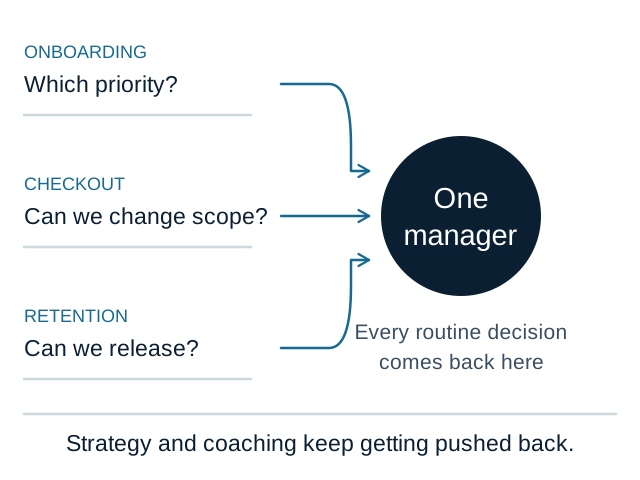
Context and decision boundaries
Giving teams enough shared context and authority to decide without escalating, while the Product Team stays accountable.
Put it into practice
List recent decisions that were escalated or approved centrally and agree which of them Stream Teams will own, with the Product Team certifying the reasoning.
Topics covered
- Certify, Don't Brief
- Core values and operating principles as decision guides
- Highly aligned, loosely coupled teams
- Distributed authority compared with flat hierarchies
- Default decision rights across Stream, Product, and portfolio levels
Reviewing evidence each week
Replacing status reporting and approval steps with transparent work and a weekly look at outcome metrics.
Four layers of metrics
- InputHours workedEffort investedTime spent doing the work.
- OutputChecklist shippedOld model stops hereDelivery is treated as done, even if nothing changes for customers.
- OutcomeMore customers signed upZeroBlockers: accountable hereThe work is done when the outcome is achieved.
- ImpactRevenue upWhat the business wantsWhat the business ultimately wants. It moves too slowly to steer day-to-day product decisions.
Put it into practice
Draft a Weekly Product Report for one Stream Team from the prepared case, then present it in the Weekly Product Review format while the facilitator chairs the review. Write the first real report from your own metrics in the week after the module.
Topics covered
- Stream Kanban boards rolled up into a product-level view
- Weekly Product Report and Weekly Product Review of metric variance
- Targets kept separate from forecasts and funding
- Metrics review and scope and funding assessment
- Traffic-light release governance: Green, Amber, Red
Removing blockers and improving the system
The leadership style, culture, and process measures that keep teams moving, and the rare cases that still need coordinated work.
Put it into practice
Pick the recurring blockers your Stream Teams have raised, assign a leader to each, and agree the process health metrics you will watch.
Topics covered
- Servant leadership and removing roadblocks
- Process vision: zero blocking dependencies from idea to satisfied customer
- Process health metrics: evaluation time, lead times, release frequency
- Westrum culture types and blameless postmortems
- Criteria for running projects and the Program Management role

Practical results
What the cohort leaves with
- A responsibility map for the Product Team across the seven areas, with gaps and owners
- Draft working agreements covering context provided, decision boundaries, and escalation triggers
- A Weekly Product Report populated for one Stream Team and an agenda for the Weekly Product Review
- A short list of process health metrics, with current baselines where data exists
- A blocker list with a named leader against each item
Before the module
Bring a one-page view of current product metrics, a few examples of recent decisions that were escalated or delayed, and the blockers teams have raised. The Product Manager and functional leads should attend together, since the agreements are made between them.
The company learning plan
Where this module fits
Part of the Product Teams courses, taken at the Lead the product teams stage of the implementation.
See all company courses →Product Teams
- Leading a product team of teamsThis course
- Vision and strategy →
- Staffing and developing capability →
- Aligning structure to strategy →
Explore the supporting documentation
- Product Team
Roles, the 7S areas, and how Product Teams work
- Governance (framework)
Stream boards, weekly reviews, and the traffic-light release model
- Certify, Don't Brief
The practice of validating outcomes without prescribing the work
- Weekly Product Review
Purpose, inputs, and anti-patterns of the weekly metrics review
- Weekly Product Report
The consistent chart format used in the weekly review
- Defined Interaction Modes
The four modes and why Aligning differs from Facilitating
- Process Health Metrics
Six example metrics for the health of the development process
- Criteria for Running Projects
When cross-team projects are justified and the two collaboration formats