ZeroBlockers foundations
Understand the six connected changes that help small, AI-assisted teams turn faster delivery into better customer outcomes.
- Who it is for
Everyone, from the leadership team to individual contributors
Everyone taking ZeroBlockers training, including executive and transformation leaders and members of every team type.
Examples and exercises are adapted to the cohort’s responsibilities.
- Duration
- 1 day
Inside the module
What the module covers
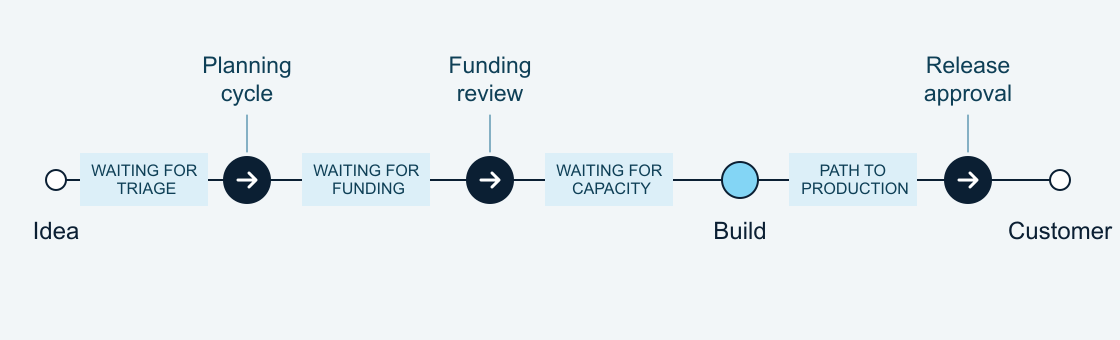
AI has made building software fast, and the delays now sit in the organization around the teams: business cases, sign-offs, handovers, annual funding, and quarterly planning.
This module gives everyone involved a shared picture of the four principles behind ZeroBlockers and the six connected changes (Process, Structure, Governance, Funding, Alignment, Scaling).
By the end, participants have practiced how to
- Explain why most features fail using the knowledge, alignment, and effects gaps, and why faster building raises the cost of that failure
- Trace a piece of work from idea to customer and separate the time spent working from the time spent waiting in backlogs
- Name the benefit each current sign-off provides (funding confidence, alignment, governance, quality, scale) and an alternative the team can control
- Describe the six changes in order and how each one creates the pressure for the next
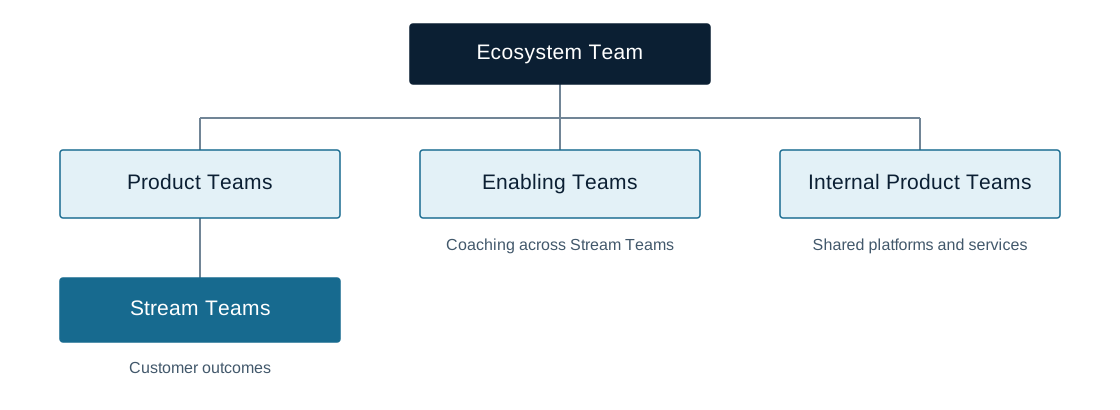
- Distinguish the five team types by what each owns: Stream, Product, Enabling, Internal Product, and Ecosystem Teams
Module outline
How the time is spent
Each part ends with a short exercise, on your own work where you have it and on a prepared case where you do not. We adapt the examples and emphasis to the people in the room.
Where the time goes
Why the operating model built for slow, expensive engineering has become the bottleneck now that building is cheap.
Put it into practice
Take one recent piece of work and map its path from idea to customer, marking every queue, handover, and approval along the way.
Topics covered
- Most features fail to deliver the expected value
- Why locking in solutions early is the cause
- Cynefin: product development as a complex domain
- Work waiting in backlogs and the Coordination Tax
- What AI changes: more output than the organization can absorb
Four principles and the purpose of sign-offs
The four founding principles, and how to keep the benefits of business cases and stage gates without locking in solutions before they are validated.
Put it into practice
Go back over the approvals on that map. For each one, name the benefit it provides and one way a team could deliver that benefit without a queue.
Topics covered
- The four founding principles behind the framework
- What business cases, stage gates, and functional structures protect
- Team-owned controls: automated tests, feature flags, fitness functions, automated rollbacks
- Why outcome accountability requires control over the solution
- Funding outcomes over outputs, and the CapEx and OpEx effect
Process, Structure, and Governance
How a Stream Team with two to four people works, where its boundaries come from, and how leaders review outcomes weekly in the Weekly Product Review.
Put it into practice
Role-play a Weekly Product Review on a prepared case: a fictional Stream Team and its one-page report, with an outcome trend, a health measure, one thing learned, and one decision needed. In groups of five or six, one person presents the evidence, the Product Team roles ask questions, and an observer checks that each decision leaves with an owner and a date.
Topics covered
- The continuous loop: research, design, development, improvement, no handovers
- Stream Team roles: Designer and Developer core, specialists by stream
- Ways to create autonomous teams: splitting by function, feature, journey stage, or technical entity
- Stream Kanban Board and the Weekly Product Review of metrics
- The traffic-light release model: Green, Amber, and Red

Funding, Alignment, Scaling, and a starting point
How the Product Team (the leadership group for one product) funds and directs many autonomous teams, how Enabling Teams (senior practitioners who coach) and Internal Product Teams (shared services run as products with voluntary adoption) support them, and where a first bounded step could begin.
Put it into practice
Each participant writes their understanding of the product strategy in three sentences, alone. The room compares the results, and the number of different pictures is the finding. The day closes with a short conversation about where a first bounded step could begin.
Topics covered
- Funding value streams by strategic importance against outcome metrics
- Translating business metrics into product metrics for each team
- Product Vision, Product Strategy, and the Annual Plan
- Separating targets, forecasts, and funding in annual planning
- Internal Product Teams, Enabling Teams, and the Ecosystem Team


Practical results
What the cohort leaves with
- A map of one real piece of work from idea to customer, with waiting time and approvals marked
- A list of current sign-offs, the benefit each provides, and a candidate replacement the team could own
- A shared view of how a Weekly Product Review runs, practiced on a prepared case
- An honest count of how many versions of the strategy the cohort holds, and a first conversation about where to start
- A shared vocabulary for the six changes and five team types across the cohort
Before the module
Choose one recently delivered feature or initiative and bring what you know about its timeline: when the idea was raised, when it was approved, when work started, and when customers received it.
The company learning plan
Where this module fits
Foundations is the shared starting point. The leadership team takes it before a pilot starts, and each team takes it when its own part of the change begins, alongside the courses for their team.
See all company courses →What follows for each group
- Equip the pilot team →
The Stream Team and the practitioners supporting its work.
- Lead the product teams →
Product and functional leaders responsible for direction, team boundaries, and people development.
- Scaling support →
Senior practitioners and leaders of internal departments supporting teams across products.
Explore the supporting documentation
- The ZeroBlockers Framework
The context, the benefits of sign-offs, and the six changes
- The ZeroBlockers Framework Principles
The four founding principles and what AI changes about them
- Principle 2 - We can't manage dependencies, we must remove them
Backlogs, the Coordination Tax, and team-owned replacements for blockers
- Process
The continuous loop and the six process principles
- Structure
Ways to split teams, example value streams, and team roles
- Governance
Stream boards, weekly metric reviews, and traffic-light release model
- Alignment
Translating business metrics and sharing vision, strategy, annual plan
- Scaling
Internal Product Teams, Enabling Teams, Ecosystem Teams, and Program Management