Running an internal service as a product
Help Finance, HR, Legal, technology platforms and other shared services work as Internal Product Teams. Understand the teams you serve, make the common case self-service, and review adoption and reliability.
- Who it is for
Internal Product Teams
Leaders and practitioners responsible for Finance, HR, Legal, technology platforms, and other internal services.
Product leaders and representatives of the teams using those services, who can help define needs, boundaries, and measures of usefulness.
Inside the module
What the module covers
When a Stream Team can ship in days, an internal service that takes weeks to respond becomes the longest step in its work.
This module helps Finance, HR, Legal, platform, and other shared services operate as Internal Product Teams: teams that treat Stream Teams as customers, make the common requests self-service, and measure themselves on voluntary adoption.
By the end, participants have practiced how to
- Identify the recurring queues between Stream Teams and an internal service and rank them for productization
- Apply the rule of three and the three productization signals to decide what warrants an Internal Product Team
- Research internal customers with the interviews and observation that Stream Teams use with external customers
- Design a self-service interface for the common case with a clear route for novel or ambiguous requests
- Select measures to publish, such as voluntary adoption rate, time to onboard, and service level objectives
- Evaluate internal pricing against the design principles of low friction, real choice, and published prices
Module outline
How the time is spent
Each part ends with a short exercise, on your own work where you have it and on a prepared case where you do not. We adapt the examples and emphasis to the people in the room.
Find the interfaces worth productizing
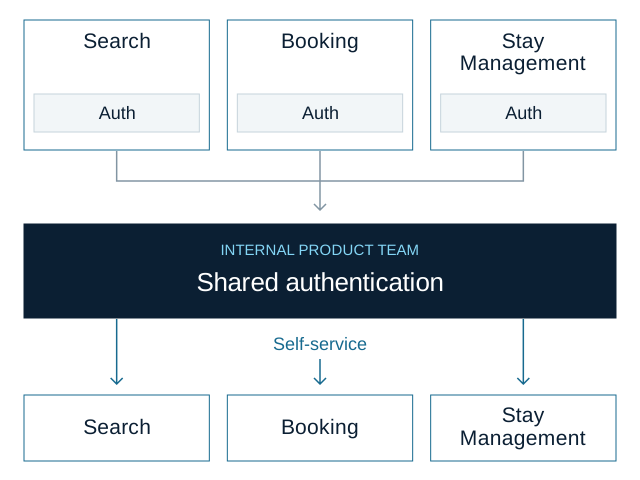
Locate where Stream Teams repeatedly wait on your service and separate real candidates for productization from premature ones.
Put it into practice
List the requests Stream Teams send your service, from the data you brought or from the team’s own estimates, rank them by volume and waiting time, and choose the top two or three candidates.
Topics covered
- Traditional departments and Platform Teams as Internal Product Teams
- Three signals that work warrants an Internal Product
- The rule of three for shared capabilities
- What does not warrant an Internal Product
- Teams routing around a slow department
Treat Stream Teams as customers
Apply product discovery to an internal service by studying how teams use it before deciding what to build.
Put it into practice
Map one internal customer journey through your service from request to result, marking where teams wait or work around you.
Topics covered
- Continuous research with internal customers: interviews and observation
- Pain points and unmet needs of the Stream Teams served
- Confirming demand across three or more teams
- The smallest useful product for the common case
- A Product Manager and roadmap for the service
Design the self-service interface
Turn repeating patterns of work into interfaces teams can use without raising a ticket, while novel work still reaches an expert.
Put it into practice
Draft the self-service option for one common request, the route for exceptions, and the legal, security, or financial obligations it still has to meet.
Topics covered
- X-as-a-Service as the cheapest interaction mode
- Templates, automated checks, decision trees, runbooks, and dashboards
- Covering the common 80 percent and escalating the rest
- Small core with extension points
- Outside examples: AWS, Stripe Atlas, and Deel
Run it as a product
Agree how the service will be owned, measured, and given a reason to keep improving.
Put it into practice
Choose the measures of usefulness and reliability you will publish, and decide how the service will respond when teams route around it.
Topics covered
- Voluntary adoption as the success metric
- Published measures: SLOs, time to onboard, adoption rate
- Onboarding, documentation, and migration support
- Internal pricing design principles and the Haier trading platform
- Regulated services where teams have no alternative supplier

Practical results
What the cohort leaves with
- A ranked list of recurring requests, with the top two or three chosen for productization
- An internal customer journey map for one service, showing waits and workarounds
- A draft self-service option and exception route for one common request
- A short set of measures to publish, covering adoption, reliability, and time to onboard
- A position on internal pricing: whether to introduce it and what alternatives teams would have
Before the module
Bring data on the requests your service receives: types, volumes, and how long teams wait. Invite two or three people from the Stream Teams that use the service, and confirm beforehand which regulatory, security, or financial obligations cannot change.
The company learning plan
Where this module fits
Part of the Internal Product Teams courses, taken at the Scaling support stage of the implementation.
See all company courses →Internal Product Teams
- Running an internal service as a productThis course
Explore the supporting documentation
- Internal Product Teams
Team types, the need for productization, and incentives to change
- Identifying Internal Products
Signals for and against creating an Internal Product Team
- Platform as a Product
Four characteristics of platforms that teams choose to use
- Internal Pricing
Design principles, the Haier example, and common objections
- Incentivizing Productization
Answers to the claim that internal work is too bespoke
- Defined Interaction Modes
Why X-as-a-Service costs less than Collaboration between teams
- Scaling
Where Internal Product Teams sit alongside Enabling and Ecosystem Teams