Building an Enabling Team
Build the coaching support that helps Stream Teams develop their craft. Define what good looks like, close capability gaps in the work, and check that teams become more capable and independent.
- Who it is for
Enabling Teams
Experienced practitioners who will coach Stream Teams and support their craft.
Functional and Product Team leaders responsible for capability development and specialist support.
Inside the module
What the module covers
When specialists are spread across Stream Teams, quality starts to vary by team and senior people become the bottleneck for routine questions.
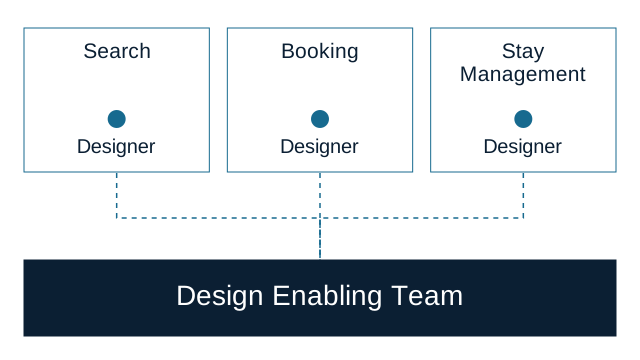
This module prepares senior practitioners to work as an Enabling Team: one or two Staff or Principal level experts in a craft who define what good looks like, upskill Stream Teams, and share knowledge across them while the teams keep doing their own work.
By the end, participants have practiced how to
- Draw the boundary between coaching a Stream Team and doing its work, using the Facilitating interaction mode
- Write capability standards that describe the expected behaviors for one craft at each level
- Find skill gaps through regular check-ins that observe teams at work, and record them in a skills gap analysis report
- Choose between coaching, an internal workshop, a curriculum, and an apprenticeship for a given gap
- Design a community of practice with a clear purpose, curriculum, and facilitation plan
- Set quarterly OKRs with the Ecosystem Team (the executive group that funds and aligns teams across products) based on adoption and capability
Module outline
How the time is spent
Each part ends with a short exercise, on your own work where you have it and on a prepared case where you do not. We adapt the examples and emphasis to the people in the room.
Scope and boundaries
Agree what an Enabling Team is for, which craft needs one first, and where coaching ends and delivery begins.
Put it into practice
List the requests your specialists receive from teams today and sort each one into coach, hand to an internal service, or return to the team.
Topics covered
- Three axes of enabling work: people, process, and technology
- Four-step loop: define good, upskill, transfer knowledge, implement tools
- Facilitating mode compared with X-as-a-Service and Collaboration
- Delivery drift in ResearchOps, DesignOps, and ProductOps functions
- Staff and Principal functional experts as the staffing model
Define good and find the gaps
Make expectations explicit for a craft and learn where teams fall short by observing the work as it happens.
Put it into practice
Write four to six expected behaviors for one level of one craft, then schedule the first two check-ins: which team, which piece of work you will observe, and which behaviors you will look for.
Topics covered
- Capability standards for each role and level
- Capability assessments for research, design, development, and process concepts
- Regular check-ins that observe teams without disrupting them
- Skills gap analysis report and good practice recommendations
Upskill in the work
Match each gap to the lightest form of support that closes it, from coaching alongside the team to a full apprenticeship.
Put it into practice
Take one gap from the previous session and choose the format, owner, and completion criteria for closing it.
Topics covered
- Coaching in the work, with training reserved for shared gaps
- Developing the curriculum and running internal workshops
- Apprenticeships with a plan, milestones, and exit criteria
- Designing and running communities of practice
- Overdependence on the Enabling Team as a failure mode
Make knowledge findable and show the value
Turn what the team learns into self-service guidance and agree how leaders will judge whether the Enabling Team is worth its funding.
Put it into practice
Outline one playbook teams keep asking for, decide where it will live, and draft two key results that show teams adopting it.
Topics covered
- Good practice guidelines, playbooks, and templates
- Central repository with search and version control
- Tool assessment: fit for purpose, support, and licenses
- Annual planning and quarterly OKRs with the Ecosystem Team
- Seeding an Internal Product Team when a practice outgrows coaching

Practical results
What the cohort leaves with
- A one-page Enabling Team scope: the craft, the teams served, what it coaches, and what it declines to deliver
- Four to six expected behaviors for one level of one craft, and the first two check-ins scheduled
- An enabling plan for one real gap, with format, owner, completion criteria, and evidence of independence
- A community of practice design with purpose, members, topics, and cadence
- Draft quarterly OKRs based on voluntary adoption and capability against the standards
Before the module
Decide which craft is in scope and who the candidate Enabling Team members are. Bring examples of recent Stream Team work in that craft, any existing job levels or guidelines, and a list of the requests specialists currently receive from teams.
The company learning plan
Where this module fits
Part of the Enabling Teams courses, taken at the Scaling support stage of the implementation.
See all company courses →Enabling Teams
- Building an Enabling TeamThis course
Explore the supporting documentation
- Enabling Teams
The team, the three axes, the four-step loop, and the delivery boundary
- Staff/Principal Functional Experts
Responsibilities and artifacts of the people who staff an Enabling Team
- Establishing Capability Standards
Defining benchmarks for each role and level in a craft
- Regular Check-Ins
Observing Stream Teams at work to find gaps they cannot see
- Apprenticeships
When coaching is insufficient and how to structure supervised practice
- Designing Communities of Practice
Giving a community clear objectives, curriculum, and support
- Process
Guidelines, playbooks, templates, a central repository, and seeding internal products
- Defined Interaction Modes
Facilitating, Aligning, X-as-a-Service, and Collaboration compared